Madeline redivivus
KripkeFest: Twenty thousand and counting

[This is somewhat out of character and fwiw I find it harder to write than usual. Could of course be the jet-lag. Did I ever really go? Not wholly certain. But I did come back. Market day chez nous. Food snob as ever I discussed the hotel ‘bread’ with Madame la boulangère. I ended, ‘Mais aujourd’hui, retour en civilization.’ Slang texts are easy in comparison, one is usually sustaining some kind of low-key fury, some synonym for what is simply expressed as whinge. Positive appreciation? Now there’s my prob.]
Symposium: ‘A drinking-party; a convivial meeting for drinking, conversation, and intellectual entertainment’ (OED)

Yup. That’s about it. Not perfect, at times quite the opposite. Fitful pre-flight sleep seen off by an 0445 ping to announce that the first (long and thereafter connecting) flight was delayed by two hours. For the in-country variety one received texts, obsequiously optimistic, consistently mendacious; there was much watching the agonising sloth of the plane’s digital progress across the Ditch and back, yet there was the compensation of pleasant seat-mates and surprisingly edible meals. Sufficient drink. The tornado-plus-lightning-flecked rainstorm that accompanied us from the airport lacked much charm, but one cannot deny a certain melodrama. But that was only the top ’n’ tailing and SMS alerts aside, was it not ever thus? In truth, I travelled hopefully. For once it was born out and I thank all concerned.
So: Madeline redivivus? Slang’s Jewish mother superior reborn? No. Not exactly, though the vast wall-length banner that greeted visitors to the Lilly Library1 at the U. of Indiana (Bloomington campus) certainly reminded visitors of the flesh and blood that had vanished in April 2020. They do you well, these US colleges (even if in this case the ‘Bookstore’ has not carried its titular stock since the Eighties and now celebrates only the facsimile outerwear and allied impedimenta - balls, helmets, the rest - of muddied, if nationally triumphant oafs, plus a sidebar in emergency toiletries which come in useful for travellers forbidden to transport them for fear of little terrorists), and will fete what they must, whether the soi-disant but increasingly loathed ‘president’ desires it or otherwise.2
The symposium in honour of the late Madeline Kripke, the world’s greatest ever assembler of a library based primarily on slang texts and other lexicographic items, was entitled The Whole World in a Book. Which all-encompassing volume was thus privileged was not specified3, but the image contains a necessary resonance, such are these labels, and the unpackaging and rudimentary (so far) cataloguing, has reached 16,000 out of an estimated 20,000 contenders. Several pallets (as in groups of boxes taken straight - and apparently unsorted beyond Madeline’s long-established ordering - from the original double-ranked shelves in Perry St, NYC), plus whatever was the number of out-stores (some said five, others three and the question remains unanswered) are yet to reveal their treasures.4
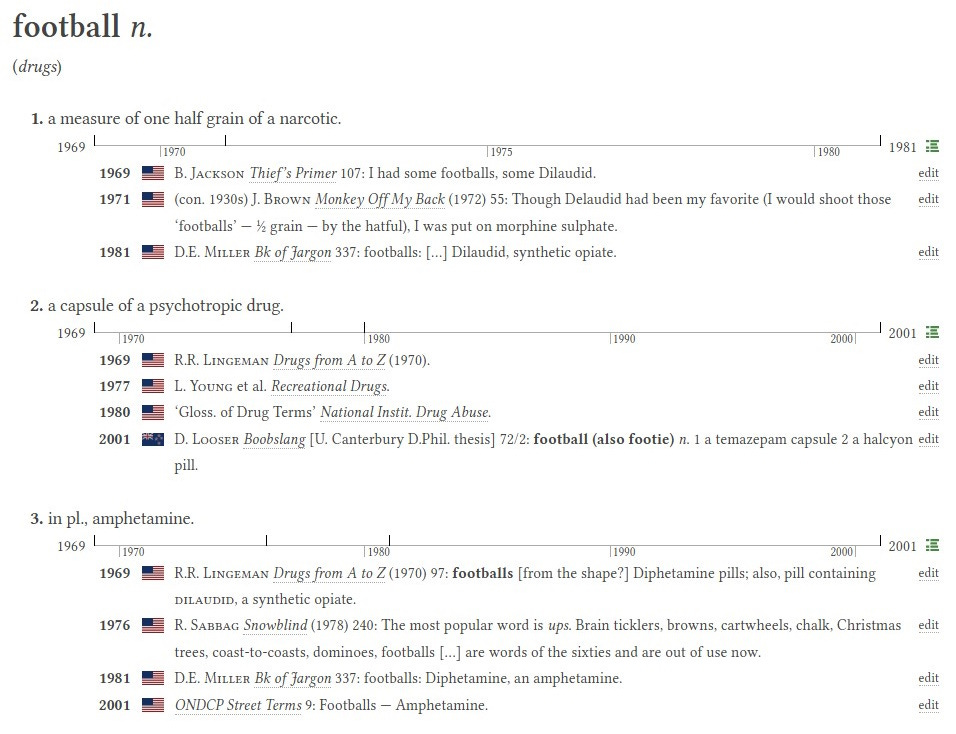
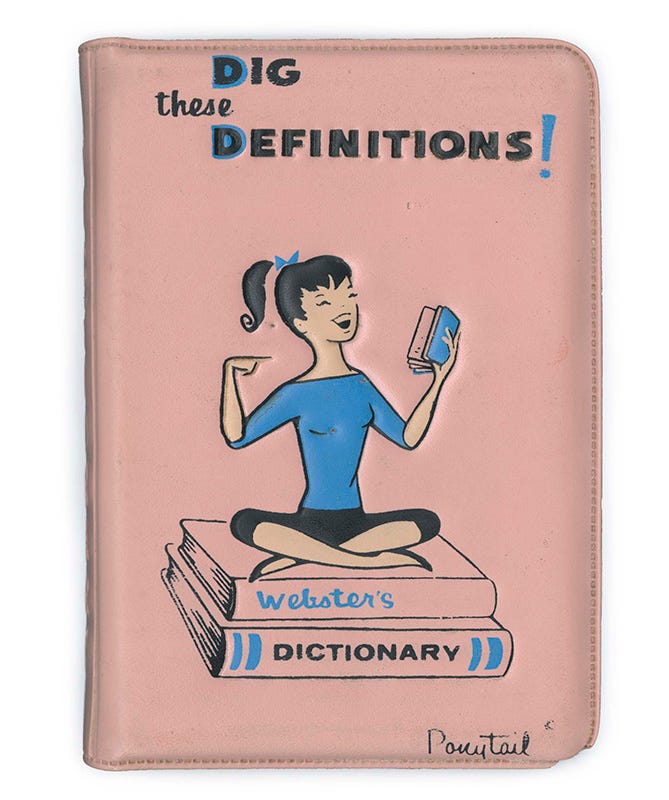
The get-together accompanied an exhibition-cum-sampler - several glass cases - of such treats as had been excavated so far. My apologies, I failed to take notes/pix, but there were examples not merely (?) of the core slang library, every one a gem, but of her equally important (to scale) collection of Tijuana Bibles and various fun ephemera (i.e. ‘Dig These Definitions!’ below) and the priceless material she had gathered regarding the dictionary publisher G.C. Merriam at the time it took over publication of America’s great dictionary maker, Noah Webster. What remains to be revealed is unknown, but breath is undoubtedly being held.
All of which fits to perfection with the Lilly’s existing holdings, themselves a surprisingly heterogenous collection5 of those sub-sets left in bequests, gifts and, when possible and/or necessary, acquired with some agglomeration of Damon Runyon’s ‘coarse G notes’. Their total value is undisclosed, but let us note that two large storage rooms boast doors that would not look beyond place in a traditional heist movie. Whether there were invisible rays criss-crossing the space, I cannot say, but apparently there had been some kind of gas release system but it was removed, deemed unfriendly to the rag- or vellum-based glories within. And with a few exceptions, usually based on condition, all is available, with due warning, to researchers and similar interested parties. There are guided tours, and we received one. I do not envisage time to return, but I would be even more than usually stupid to deny that some of Madeline’s tomes might not bear serious investigation.
A drop in this ocean, but personally pleasing in its display, was ‘my’ edition of Francis Grose’s Classical Dictionary of the Vulgar Tongue, marked up in handwritten notes, pages bound into Grose’s copy of the the original 1785 edition, which would become the foundation of the revisions of the successor in 1788, the last published in the author’s lifetime.6 It had been, of course, the source of my falling out with the ‘Dame of Dictionaries’.7 It was explained to me that this was not merely the cussedness of what I see as the entitlement of a collector of Madeline’s grandeur, the cause that I had ascribed to our falling-out. The volume I had purchased was one of three such: it was the biggest as regarded Grose’s add-ons, and lexicography being size-determined as it is, the best. Madeline had the lesser versions two and three. Unwittingly I had denied her the best of breed. I am sorry, my dear, truly sorry, though I doubt that I would have withheld pen from cheque had I known. In any case, while it was bought by the Lilly and while thus not officially a part of the Kripke thesaurus8, it is effectively a part of it now.9
There was more that might be learned. I kicked off the day. Something on the lines of what I wrote here recently. Those who joined me were (in order of delivery) a variety of luminaries and all worth hearing: Jack Lynch, offering a general look at dictionary collection, Lindsay Rose Russell on the Queer Art of Collecting which subjected Madeline in particular and collection in general to queer theory and launched an intense, but unresolved sidebar regarding Madeleine’s own sexuality, far from least of her interests (her Sixties’ diaries offer regular lists of her lovers, not to mention her drugs of choice); superstar bookseller Rob Rulon-Miller on Madeline’s brief career in that trade, plus more sex with her revelation ‘I was quite a hottie once’; the Pentagon’s Elena Wicker, a specialist in the arcana (often acronymic) of military terminology and Volker Harm, chief editor of Germany’s Wortgesichte, who explained the dictionary-collecting sideline of composer Richard Wagner. We also had, the evening before, an amuse-bouche Q&A between Stefan Fatsis (something of a George Plimpton de nos jours) whose latest book is Unabridged (‘the thrill of and the threat to the modern dictionary’) and Indiana U. professor Michael Adams, co-organiser of the symposium.
All of these, need I really make the point, played hell with my imposter syndrome. Slang doesn’t score high on the awards (my sole gong was, who’d have guessed, one that comes without pecuniary bonus), but my distinguished companions seemed to to do so. I thank them for their toleration. My uncle’s legatory generosity may have rendered me the perquisites of what was once named (not wholly affectionately?) a ‘gentleman scholar’; my reality only underlines my lack of qualification for either description.
So we did, or so I believe, honour Madeline, whose life and memory brought us all together. In doing so we fulfilled the meaning of symposium (its etymology being the Greek for ‘drinking-companion’). We met, were convivial, drank, conversed and essayed intellectual entertainment. I can only thank organisers Michael Adams, both fellow-slangster and much-appreciated friend and Erika Dowell of the Library, director of the Library Joel Silver and everyone of the Library’s staff who made everything, even unto the jet-lag, so worthwhile.
To our absent friend! Bumpers all round, and no heel-taps.
That would be Josiah K. Lilly Jr. of the pharmaceutical company who founded the great repository of rare books and manuscripts in 1960. More here: https://en.wikipedia.org/wiki/Lilly_Library
That said, while Bloomington is a college town and thus, by tradition, largely ‘blue’, Indiana writ larger is staunchly ‘red’ and things change beyond the city limits. (They are also changing in-house, where the state’s wowsers, the university’s ultimate rulers, are doing what they can to crush the wicked academic woke). No sign of the Trumpian Myrmidons and their tax-provided dress-up and attendant bang-bang toys. The proliferation of other exploitable and fellow-travelling (grovelling?) superstitions, however, is underlined by the churches that can be seen where’er the the passing eyes alight. The Great Huckster’s natural mini-me’s. I trust snakes are brandished and tongues spoken. Cue quotes from Barnum, Mencken et al.
Given slang’s predominance in the collection, I’m not wholly happy with that ‘whole world’ concept. As we know (and as I’ve been saying for decades) slang’s ‘world’ is limited: its primary concerns a figurative equivalent to sex (and the bits with which we perform it) and drugs (and other stimulants / depressants of the nervous system and the results thereof) and whatever form of lit. or fig. excess you care to define as ‘rock ‘n’ roll’. Little abstract, much concrete. Come on in Mr Cruel, but we are only reluctantly at home to Ms Kind.
This may have been said before, but in ur-Kripke-land (i.e. Madeline’s New York apartment) shelf is a flexible term. All that remains of the quotidian definition is ‘something upon which one may place one or a number of printed texts or illustrations’). As those who visited her knew, Madeline’s storage (and she knew every inch however random, even crazy the naive outsider might mis-assess it) was omnivorous: the bed, the bath, the stove… it’s flat, so what’s not to use?
The mighty double-elephants of Audubon’s Birds of America might be expected, a variety of 9th century vellums too, but director John Ford’s Oscars? The world’s greatest collection of three-dimensional puzzles?
Sadly, the page chosen did not offer arse man, an early and inevitably derogatory synonym for a male homosexual, but we cannot have everything. Nor, ultimately, did Grose chose to include it in his own published work; it would not meet a dictionary till the 1940s.
My fellow-speakers brought me much new information about our honoree. One thing being that her falling-out with me over the manuscript Grose was, far from a one-off, very much par for her course. You crossed her, noted several anecdotes, very much at your peril. Towards the end of her life she may, as one speaker put it, have resembled a bit of a bag-lady, but she had the street-sturdiness as well.
from Greek θησαυρός a store, treasure, storehouse, treasury.