Kids’ Stuff

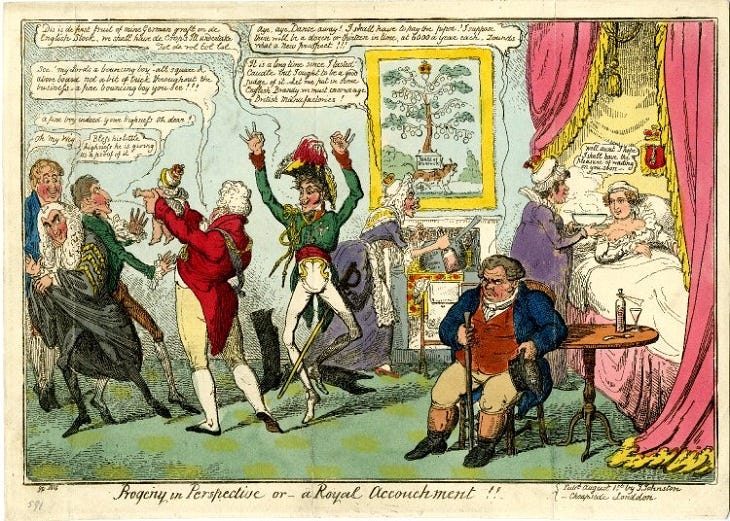
[The first child born to the then Cambridges, now Waleses, emerged brandishing its silver spoon in July 2013. There was debate over the name but he now appears as Prince George which, failing a radical re-assessment of his family’s role in the nation’s mythology, will one day make him George VII, a high number for his job. (Only Edward VIII, the monarchy’s Liz Truss, and multi-married Henry VIII have surpassed him). Writing my Dabbler piece for that week I found this an excuse to touch on slang’s terms for children. Not an especially well-represented group, since the strict delineations between child and adult, had yet fully to merge until the 20th century. It was more a matter of age, and society saw less reason to surround a given year or years with special, supposedly protective, in practice restrictive strictures.]
I love children, as Nancy Mitford put it so well, especially when they cry: for then someone takes them away. Mitford of course lived in Paris where they have a more robust attitude to those who have yet to acquire a civilized palate and where, only yesterday [i.e. in July 2013], a Parisienne, while gurgling with the best of ’em, on hearing that I was English observed, Alors M’sieur, la grande question: qui était le gran’père. Bien sûr, ce n’était pas Charles.1
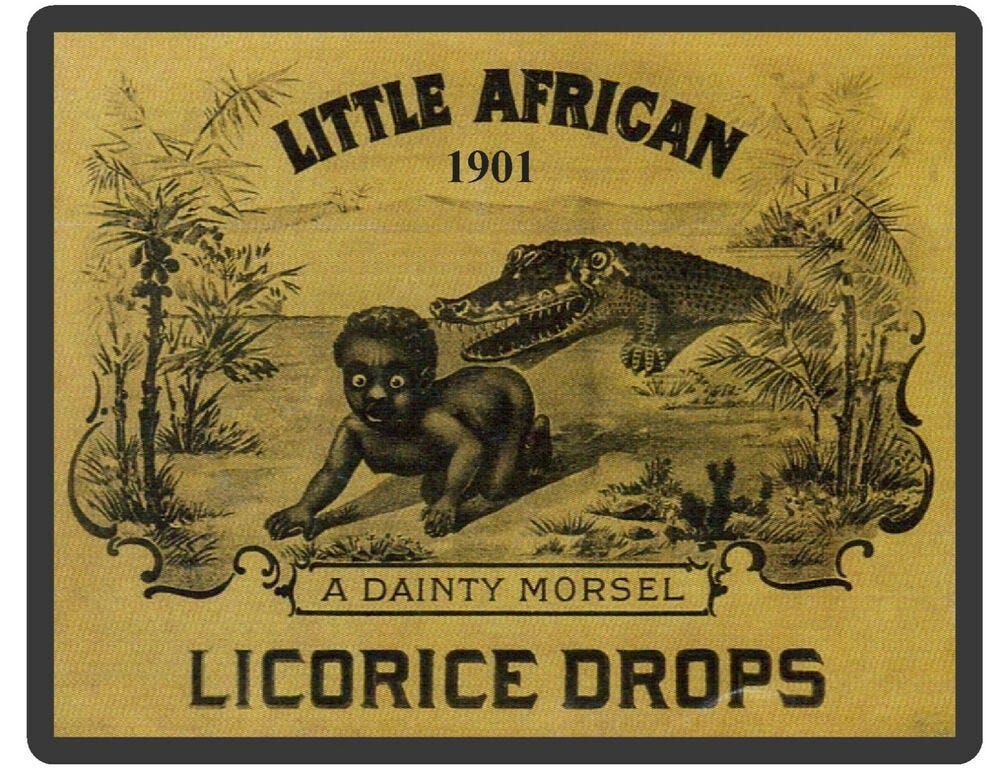
One fears that Ms Mitford might have embraced racist America’s alligator-bait, the image taken from the practice of Southern whites who found it amusing to threaten small black children with ‘throwing them to the alligators.’ Whether things stopped at threats is debatable: a Honolulu newspaper of 1897 reported on a photo of ‘a dozen negro babies [...] the title is ‘Alligator Bait’ (and refers to the special tooth of the alligator for the little pickaninny).’ The story was used to promote sweets (below) and an even nastier use of the same image promoted the cleaner ‘Stainilgo’ and was tagged ‘For the Removal of Discolorations’.2
Slang, being among those who demand that an article precedes all uses of the word ‘baby’, averts its gaze from the current hysteria and finds a suitable representative in Mr S. who, as a diabetic, can only tolerate a limited sickliness. This is not to wish the newborn, who has rocketed straight into the entitlement charts at the number three slot, the slightest ill, but merely to preserve a decent distance.
But slang is nothing if not of the moment, so let us ponder a couple of examples of its infantine terminology. The oldest term, kinchin, springs from cant, the beggar tongue, around 1560. It comes from German Kindchen, a small child, and gives a variety of compounds. The kinchin co (co abbreviating cove, a bloke) is a child who has been brought up to thieving as a profession, an ‘ydle runagate Boy’ says Awdeley, and Harman adds ‘that when he groweth vnto yeres, he is better to hang then to drawe forth’. Grown older he regains his terminal -ve and as kinchin cove becomes a man, albeit short. The kinchin mort, the ever-moralising Harman again, ‘is a little Girle, the Morts their Mothers carries them at their backes in their slates, which is their sheetes, and bryngs them vp sauagely tyll they growe to be ripe, and soone ripe, soone rotten.’ Such a child might not be one’s own, what mattered was the pity it might excite and B.E. noted in 1698 ‘if they have no Children of their own, they borrow or Steal them from others.’ This has not changed: as in many urban rogueries, the modern city illustrates that beggary works with a well-honed repertoire. The 19th century added kinchin prig, a young thief, and the kinchin lay, thus kindly explained to Oliver by Fagin: ‘The kinchins, my dear … is the young children that’s sent on errands by their mothers, with sixpences and shillings; and the lay is just to take their money away.’ Alternative versions included the kid rig (rig: a con-trick) and to go upon the kid, to steal parcels from foolish errand boys who believed it when you promised to ‘hold on to them while you make another delivery.’ Given the duplicity, the term may be underpinned by the verbal form of kid, to tease, to deceive, which itself stems either from ‘treat like a kid’ or the synonynous cod.
The arrival of kid underlines the fact that by Fagin’s day it had become the dominant word, extending far beyond cant, though it played its role therein. And kid, as we know, is one of slang’s great stayers, elbowing its way into the mainstream long since and effectively replacing what, by implication, has become the middle-class prissiness of child. (Though young royals, even in the most hail-fellow of tabloids, do seem to escape ‘kid’, moving in popular eyes directly from the vaseline-lensed world of Start-rite and Blyton to ‘Randy Andy’3 or whatever).
Kid, it appears, comes from the zoological name for a young goat. Middleton and Rowley used it in 1627, their line bracketing it with brat (and jeering at the impotence of one ‘lank suck-eggs’). By the 18th century it had been scarfed up by cant, and naturally described a youthful thief of either gender, trained up by a kidsman. If the father was already in the business, the infant villain was a kidwy (i.e, kid-wee) or kidling, though the latter came only to mean baby. In 1812 the knowledgable transportee James Hardy Vaux noted how ‘when by his dexterity he has become famous, he is called by his acquaintances the kid so and so, mentioning his sirname’, an ancestral precursor, perhaps, of such monickers as Billy the Kid or The Cisco Kid (though slang’s use for those is simply to rhyme with ‘Yid’. The Milky Bar Kid, however, is an Australian synonym for petty criminal).
The term widened, though faithful to its origins. Meanings came to include a member of a confidence team, a teenager (though that word still was far off), a form of address, and a reference to one’s younger sibling, ‘our kid’. By the late 19th century sex had arrived. The kid had become a catamite, whether as a tramp’s companion (though the main US term was gay-cat, even if for all the possibilities, there is no hard proof that this ‘gay’ was that of modernity) or the prison pretty-boy also known as a punk. A kid fruit, who pursued such company, was a synonym for the modern chicken-hawk.
Sometimes the sex was offered, as by the kid-leather, the young whore (leather meaning skin or more coarsely the vagina, which could be stretched or laboured.) More often it was sought after: by the kid-stretcher or kid stuffer, both of whom, in their paedophiliac obsessions, are known as kid-simple. Such usages predate or parallel the creepily infantilizing alternatives based on kid’s diminutive kiddy, which in such compounds as kiddy-porn or kiddy-fiddler have been around since the 1980s.
The term was launched with no such overtones. Kiddy as in child is in place by 1800; modified by ‘my’ it addressed a friend by 1850. The early 18th century has it as a fashionable, flashy young man, a rake, a pimp or a thief; and compounds it as rolling kiddy, a dandy-cum-thief, or a dandy who dresses like one. His girlfriend, noted Egan during Tom and Jerry’s trip to the East End’s All-Max tavern, was a kiddiess. Around 1850 it denoted a hat, fashionable among small-time but dandified thieves, featuring a broad ribbon passing through a large buckle at its front.
There are, of course, many more terms than this. To return to the cradle we have cockatrice (a ‘monster born from an egg’), the loosely rhyming basin of gravy = baby, Ireland’s scaldy, which otherwise refers to one who is bald, an ankle biter and a crumb-catcher (or crusher or grabber) or crust-buster. The infant might be a snoozer, a teether, a milk-bottle and a snapper or breadsnapper, The newborn, borrowing a term more usually used of a newly arrived immigrant, could be a johnny newcome. While a split-arsed one can mean any woman, it usually highlighted a baby girl. Rhyming slang inevitably added its mini-lexis: billy lid, bin lid, dixie, saucepan, teapot and tin lid; front-wheel skid and God forbid all play on kid. Fly tipper is a nipper, a word which seems to take its origin from the slightly earlier mid-19th century term for a small measure of spirits. Haddock and cod, a sod, i.e. an irritating person, was often aimed at the young. Gawdelpus, resolutely Cockney but with no apparent rhyme, simply mourns the horrors of parenthood.
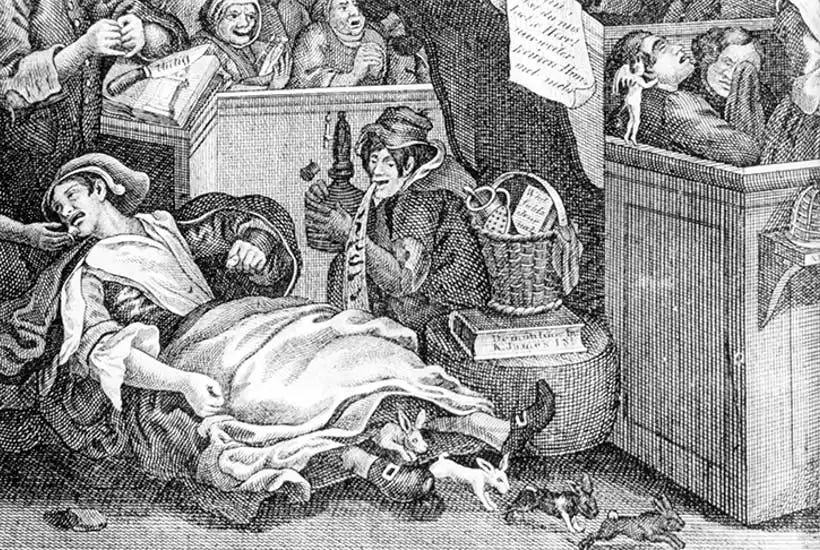
Snork otherwise means a piglet, while rabbit is only found in compounds, thus rabbit-catcher or -snatcher, both meaning a midwife (the ultimate reference may be to one Mary Tofts (c.1701–63) who, in 1726, allegedly (but fraudulently) ‘gave birth’ to a litter of rabbits.) Sprog, coined during World War II and popular thereafter, may link to the 18th centgury sprag, a lively young fellow (and the military uses sprog to mean a recruit).
The hard voice of economics gives African-America’s expense. I shall leave you with New Zealand’s parcel from Paris. This presumably implies the usual ooh-la-la stereotype but that doesn’t usually extend to procreative intercourse. A parcel, on the other hand, is somewhat more substantial than a French letter.
‘So, monsieur, the big question: who’s the grandfather? One thing’s for sure: it isn’t Charles.’
The debate is assessed in depth here: https://medium.com/the-collector/black-babies-used-as-alligator-bait-in-the-u-s-4b0540f4b40c
In 2013, whatever the bon ton may have whispered, the wider world had not appreciated just quite how ‘Randy’ Andy might be.
[revised with additions from The Dabbler 22 Juily 2013]