Faraway Places
A mystery tour, magic or otherwise

[Wrote something the other day. Full of searing vitriol, merciless excoriation, savage imagery, incontrovertible truths, and, on reading it through a few times, of pretty much unparallelled shit. Got it off my chest, which I suppose was good, but the word self-pity springs forth and I prefer to eschew such foolishness. City Hall remains a tough customer, even with demonstrations that span both extremes of the city limits. The fash won’t and don’t go voluntarily. That was not, however my topic, but the end product was not so dissimilar. Lone figure shakes fist at juggernaut. Juggernaut rumbles on, quite probably doesn’t even notice, and either way we are talking pavement pizza.
So let me put off the agony and set aside the whingeing style. Whogivesafuck?! Let me, instead, delve once more (I haven’t been there for some time) into my book Stories of Slang, published 2017 and thus old enough to have been forgotten, and offer a thumb-plucked goodie. To wit, a swift world tour. Factual and fictional both, appropriated in all cases by slang, let us spread the map, drop a few pins, and identify a few of slang’s faraway places.]
Once upon a time, let’s say pre-1600, there wasn’t any difference between dictionaries and encyclopedias. The idea was that a good reference book offered all knowledge, or at least all sorts thereof, and why differentiate. To an extent, notably in certain US dictionaries, this never went away, and they persisted in providing non linguistic information, typically gazetteers of world geography, but such as Johnson or the OED decided otherwise. Dictionaries were about words, not wanderings.
Slang, cheerfully breaking most of the other lexicographical rules, breaks this too. It doesn’t produce full-on gazetteers, but dig around, there’s an encyclopedic side to slang. Mainly places, some real, some otherwise, and a few people, on just the same basis.
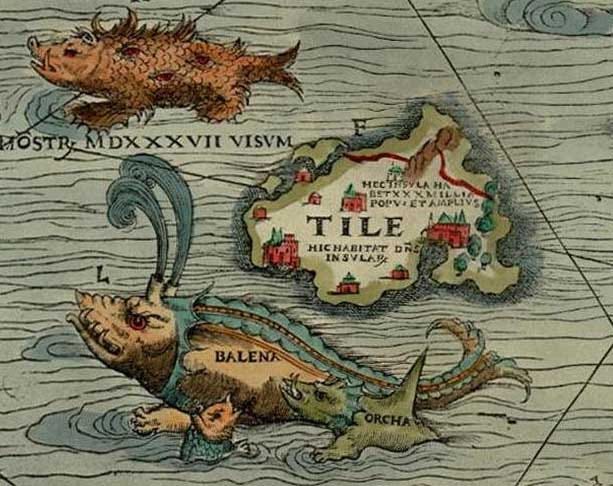
It’s not exactly slang from day one but it’s worth getting a little back-story. The idea of ‘far, far away’ first emerges in Latin’s Ultima Thule – the land of Thule being supposedly six days sail north of Britain and thus the northern limit of navigability; for Latin speakers that meant the Shetlands, while in 1771 Smollett, in Humphrey Clinker, equated it with the Orkneys or Hebrides. Since then archaeologists have named Thule as a prehistorical Inuit culture, lasting from c.500-1400 and encompassing an area from Alaska to Greenland. Moving from the specific to the general brings the back of beyond, which concept has been recorded since 1816 (Walter Scott coined it for his novel The Antiquary, though he went further in time – talking of an old Roman camp – than he did in distance). In any case even if the use is no earlier, the concept undoubtedly must be. The OED defines it as a ‘humorous phrase’ and the image, however contrary might be the reality, remains so.
Neither of those are slang, but there is no doubt about the arsehole (or asshole) of the universe, which is a place not so much distant but beyond acceptability. Alternative forms include the arsehole of creation, of the world, and the bunghole of the universe. The concept seems to have come on stream in the mid-19th century, but it’s worth noting the description of Holland as ‘the Buttock of the world, full of veins and blood, but no bones in’t’ in A Brief Character of the Low Countries (1660) and the great pamphleteer-cum-publican Ned Ward’s reference in ‘A Trip to Jamaica’ (1704) to’ The Dunghill of the Universe, the Refuge of the Whole creation, the Clippings of the Elements, a shameless Pile of Rubbish, confus’dly jumbl’d into an Emblem of the Chaos.’ In 1946 Primo Levi used synonymous Latin to describe Auschwitz as anus mundi.
It helps if one’s local topography conjures up such imagery. Sadly, the UK, ultimately limited as to its exent, isn’t really much help here. Australia and America, big countries both, come up with the goods, but the UK doesn’t cut it – John O’Groats and Lands End, Britain’s famous extremes, are too parochial, just too close. Wales can’t help: the root of ‘Welsh’ means ‘unintelligible language’ and thus ‘foreigner’ but Wales, whence Britons fled the Roman Conquest, just isn’t foreign enough. Only, perhaps, in its linguistic links to rotwelsch, Germany’s name for its homegrown criminal cant: rot means red, which takes us to red hair, seen as stereotypically Jewish and therefore, another anti-semitic trope, symbolic of cunning. The whole, therefore, ‘cunning talk’.
So the ‘tight little island’ remains just that. Getting away from it all is something for others, or at least for them to describe. The great deserts epitomize the lonely wasteland, and the Sahara, of course, boasts Timbuktu, the daddy of all such terms, first recorded in this sense in 1863. A settlement had existed since the Iron Age: the perception of isolation is purely Occidental.
Timbuktu is real. But it is, in every sense, an outlier. Australia, with its vast interior never-never (the outback was also neverland, before that image was ceded to Peter Pan and Co.) is far more productive. It is, after all, also credited with the original use of the middle of nowhere (also known, but only locally, as the red centre). Also found as the never-never country, the never-never land, and abbreviated as the never, the term was first used in 1833 of the ‘Never-never blacks’ otherwise known as Aborigines since 1803.1 The name gained wide popularity with the fictionalized autobiographical book We of the Never-Never (1908) by Jeannie ‘Mrs Aeneas’ Gunn. However, despite the logic of the English term, it may in fact come from the Gamilaraay language, spoken from New South Wales to Southern Queensland in which nievah vahs means unoccupied land, although this again may be pure coincidence; on either count it precedes J.M. Barrie’s coinage in Peter Pan (1904); a further Native Australian use is as a synonym for ‘heaven’ in the 1888 best-seller Robbery Under Arms: ‘I want to die and go up with him to the never-never country parson tell us about’. It’s pseudonymous author, ‘Rolf Boldrewood’, was in fact Thomas Browne.
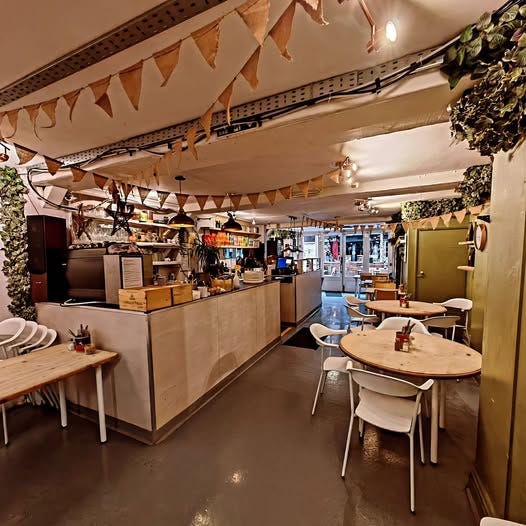
The terms offer a mix of real and fantastical. Nar Nar Goon is an actual a small town, pop. 1023 at last count, near Melbourne and well-known for the murals that deck out some of its historical buildings. The name supposedly means koala. Bullamakanka or Bullabananka has a tenuous link to Fiji bullamacow: bully beef, but it may be coincidence and there is no more such a township than there exists New Zealand’s Waikikamukau which needs to be pronounced slowly, i.e. ‘Why kick a moo-cow’, the physical manifestation of which is limited to a meat-free restaurant in Brighton, Sussex. Similarly playful are the entirely fictional Wheelyabarraback (‘wheel your barrow back’) and Bundiwallop (which may play on the alcoholic ‘wallop’ delivered by ‘Bundy,’ i.e. Bundaberg rum). The latter is also found as ‘Bandywallop’ (which was popularized by Australia’s longest-running children’s TV show Mr Squiggle, created by the puppeteer Norman Hetherington in 1959 and starring a marionette with a pencil for his nose). We may also visit, at least in America, ‘Y.U. Bum University’ (better known as ‘why, you bum, you’) and ‘Wassamatta U.’, created for the Rocky & Bullwinkle cartoon series and sounds, if properly pronounced, like a refugee from a Scorsese Mafia saga.
Oodnagalahbi has been twinned with real-life Ooodnadatta: a small town in northern South Australia but the important syllable is the galah, both noisy bird and slang for fool. Slang’s many-headed lexis of stupidity also underpins Australia’s Woop Woop, otherwise found as Upper Woop Woop, Oodnawoopwoop, or Wopwops. The derivative woop is a peasant, with all of that species’ stereotypes. Both the human and the reduplicated metonym seem to have been born in the 1930s. There is Bunyip flats, name-checking the bunyip, a supposed monster that inhabits the country’s deep and inaccessible heart. Australia has also given Hay and Hell and Booligal, anywhere hot and uncomfortable and popularized by ‘Banjo’ Patterson’s eponymous poem. Hell is of the reader’s own definition but Hay and Booligal are actual New South Wales communities.
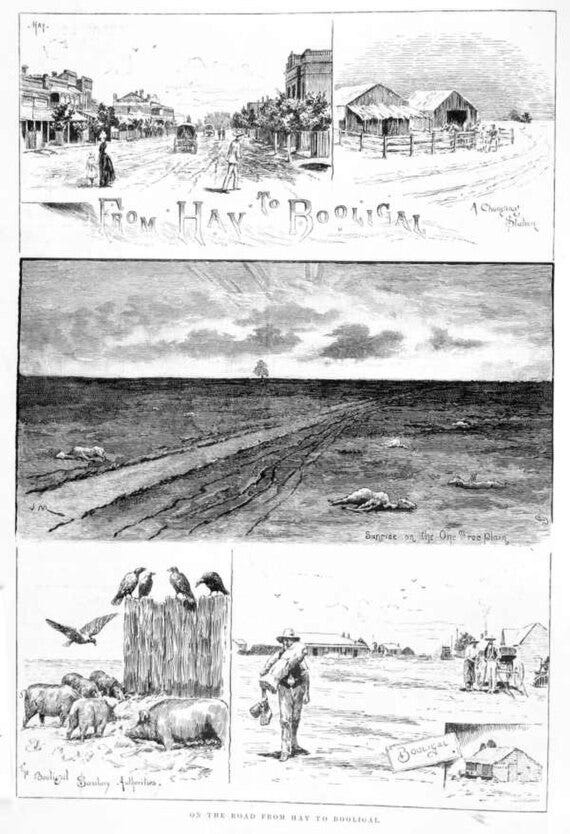
Patterson targeted Booligal: the others get off lightly:
‘No doubt it suits them very well
To say it’s worse than Hay or Hell,
But don’t you heed their talk at all;
Of course there’s heat – no one denies -
And sand and dust and stacks of flies,
And rabbits too, at Booligal.’
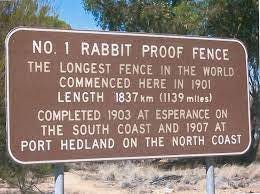
Rabbits? Indeed. The First Fleet of 1788 brought rabbits as well as humans and by the 1890s they were serious, crop-ravaging vermin. A dingo fence had been completed in 1885; now the aim was to corral the bunnies. The fence was completed in 1907. The rabbits were undaunted (myxomatosis proved more cruelly efficient) but the equation of the boundary and desolation in the phrase beyond the rabbit-proof fence was in place as soon as were the wire and palings. The contemporary over the fence, playing the abstract role, means beyond the bounds of taste.
Synonyms can be found in back of Bourke, celebrating a town in the extreme west of New South Wales which was the terminus of the railway line from Sydney and thus the start of the real Outback, and beyond the black stump, where the stump represents a symbolic marker that divides the ‘civilized’ world from the wastelands beyond; the antithesis is of course this side of the black stump. Actual black stumps, rendered thus by lightning or some other source of fire, crop up everywhere and they are useful as boundary markers or signposts. The symbolic version is recorded in 1882, though it is possible that this indicates a factual rather than figurative use. A popular etymology for the phrase cites a particular black stump at the Astro station near Blackall, Queensland, used in 1887 by surveyors involved in the mapping of outback Australia. Given that Blackall was some 1000 kilometres west of the state capital Brisbane, it was seen as the last stop before civilised life ran out. One senses that it was just one more among many.
Outside Australia one finds the Caribbean behind the bananas and behind god’s back, meaning deep in the countryside and Ireland’s back of God-Speed, a place so very far off that the positive reinforcement of one’s wish of ‘God-Speed’ to a traveller will have faded away before they arrive. Based on the Irish ‘Baile,’ that is, home or town, Ireland also presents a couple of localisms: Ballybackanowhere and Ballygobackwards; other Irish nowherevilles include Backo’beyond and Backarseanowhere.
In New Zealand the backwoods are the booai or booay which originates either in the Maori puhoi: dull, slow or Puhoi, a failed mid-19th century utopian settlement. This gives up the booai: totally confused, absolutely wrong, of plans, ruined and of items wholly non-functional. (Though Booai too, allegedly, was a genuine settlement, not that far from Auckland). Spelt Boohai, and here defined as ‘a fictitious river’, the phrase is also used to brush aside questions involving the word ‘where?’: the answerer explains that he is ‘up the Boohai hunting pūkeko (the swamp hen) with a long handled shovel’ (or ‘a popgun’).
America cuts, as ever, to the grosser aspects of the chase. B.F.E. and B.F.A. – ‘butt fucking Egypt’ or ‘Africa’ – stand for somewhere very far way. The place itself, coined by the military, is Bumfuck, Egypt, also known as Bumblefuck, Egypt, Butt Fuck, Egypt (and West Buttfuck), or, bowdlerized at least of its sodomy, as Beyond Fucking Egypt. The formation is obviously alluring, and other variations include: Bumblefuck, Bumfuck, Bumfuck Alaska; Bumfuck, Africa; Bumfucked/bumfucking Egypt; Bumfuck, Idaho, Bumfuck Junction, Bumfuck, Iowa; Bumfuck, Massachusetts, Bumcfuck, Nowheresville, Bumfuck, Texas; Bumfuck, Wisconsin; buttfucking Egypt; Buttfuck, New Jersey; Buttfuck Nowhere, Buttfuck Wherever, East Bumfuck; East Buttfuck; South Bumfuck, West Bumfuck; West Buttfuck. The points are taken.
Captain Grose’s invaders of the rear settlements, his punning definition for a homosexual (euphemising, he seems to have felt, what even for him was the noted but finally unprintable arse man) are not mandatory: there is no suggested reference to either City of the Plain and Egypt seems to exist purely on grounds of assonance; Bumfuck, while sometimes set on foreign soil as befits an image of distance, can be found deep within CONUS in many examples of the 48. Nor should bugger’s woods, while defined as out of the way and unimportant, be confused with this group. the bugger is a booger, i.e. a bogeyman, and lurks in the woods. Nor need the distance be that great: the implication of the term is simply of inaccessibility and inconvenience, be it of a parking lot or a restaurant.
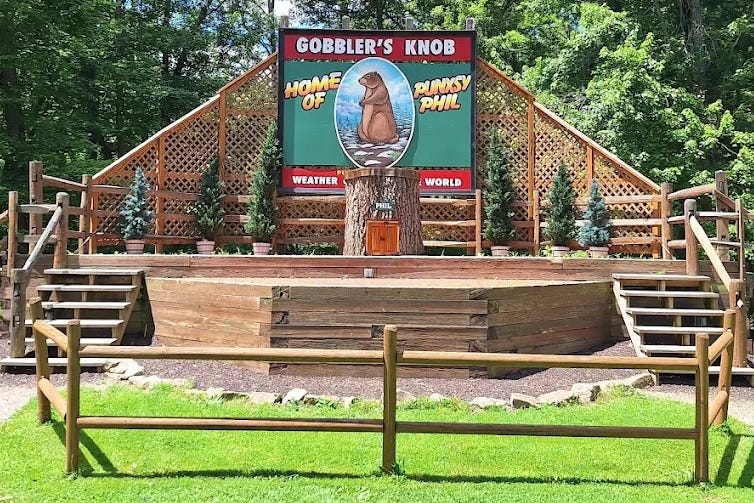
America is also responsible for the seemingly obscene Gobbler’s Knob, but like certain Australian towns, the actual place exists, in this case a small town best-known for its hosting of the annual Groundhog Day ceremony. It has no smutty link, but refers to turkeys (gobbler being an old cant name for the Thanksgiving and Christmas bird, first recorded in a slang dictionary of 1725), the rearing of which was tried by local miners when their diggings, despite flourishing around 1900, failed. Sadly, feral bobcats saw off the aldermen and bubbly jocks. Other images of inaccessibility include Doo-wah-diddy, High Street, China and West Hell. Others include the nonsensical B. Luther Hatchett) or Beluthahatchie (both just one stop past Hell itself), Ginny Gall, which refers back to the west African region of Guinea and is placed by Zora Neale Hurston as ‘four miles south of West Hell’, and Zar, apparently eliding ‘it’s there’. The implication remains that of a place that is far away, unpleasant and culturally alien.
Finally, a hole in the wall, which comes either from the holes in the walls of English debtor’s prisons, through which the inmates could obtain supplies and money to alleviate their situation, or from the small shops and similar establishments found in the broad stone walls of fortified medieval cities. Hole in the wall became a generic, although the West had its Hole in the Wall, an outlaw hideaway that provided a refuge for Butch Cassidy and Sundance Kid and the real-life Wild Bunch. Perhaps least savoury was the Hole in the Wall on Water Street, NYC, where c. 1860 its proprietor Gallus Meg (a monstrous Englishwoman) bit the ears off ill-behaved customers and preserved her trophies in a pickle jar displayed behind the bar.

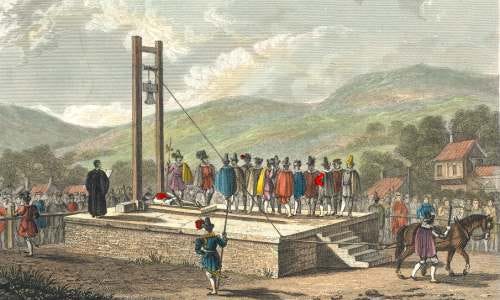
Distance is evoked in a variety of dismissals, which put more than a little flesh on the bones of ‘go away!’. There are go to Jerusalem and to Jericho (until your beard is grown) but more dramatically, go to hell, go to Putney on a pig! and Hull and Halifax, which flourished around 1600. It is accompanied by the unofficial but definitely heartfelt prayer, ‘from hell Hull and Halifax Good Lord deliver us’. Halifax in this context referred to the Halifax Gibbet Law under which a prisoner was executed first and his guilt or innocence ascertained afterwards. That his execution was effected by a newfangled machine that in its operations prefigured the guillotine of the French Revolution and beyond did not offer much comfort. As to Hull, this referred to a one-time practse of executing villains by tying them at low tide to gibbets in the Humber estuary and awaiting the sea’s return.
Early modern criminals, at least in london, might benefit from sanctuary, a form of unassailable ‘nowhere’ that existed primarily in law. The bricks and mortar and the local streets undoubtedly existed, but for whatever reason, they were beyond legal grasp. The metropolis offered three: Alsatia (upper and lower ), the Bermudas and, still thinking West Indies, the Caribees, Cribbeys or Cribbey islands.
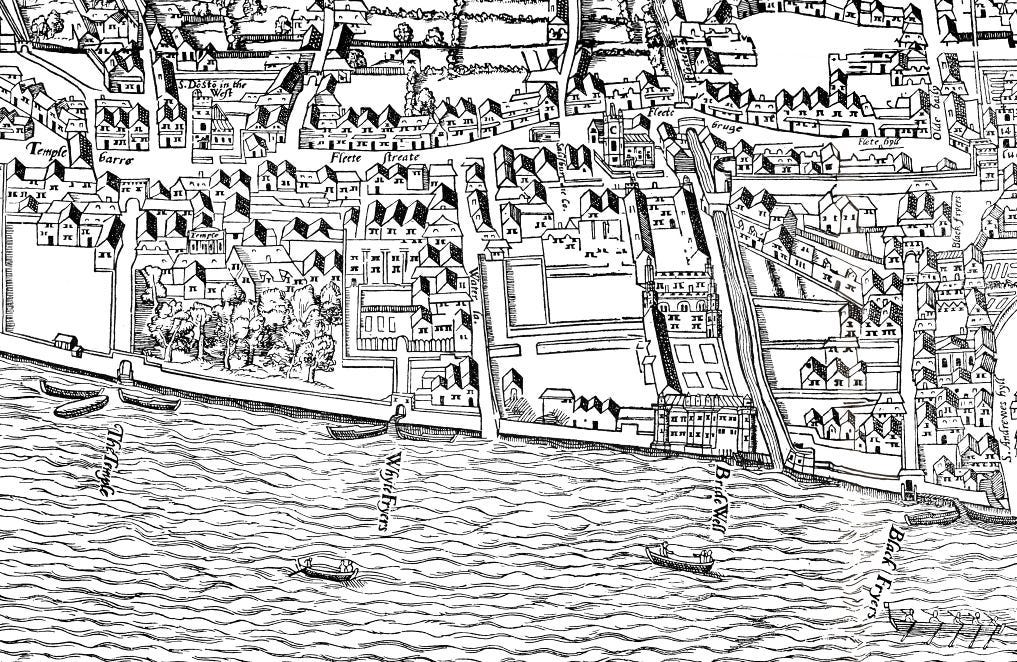
The first, Alsatia, was divided into Higher Alsatia (Whitefriars in the City) and Lower Alsatia (around the Mint in Southwark). It took its slang nickname from Alsace-Lorraine, the disputed border area between France and Germany. Higher Alsatia, its earlier manifestation, was once the lands of the Whitefriars Monastery, extending from The Temple to Whitefriars Street and from Fleet Street to the Thames. After the Dissolution of the Monasteries (1536-41) the area went downhill, and as allowed by Elizabeth I and James I its inhabitants claimed exemption from the jurisdiction of the City of London. As such the area became a centre of corruption, a refuge for villains and a no-man’s-land for the law. The privileges were abolished in 1697, but it was decades before the old habits died out. It was sufficiently well-known for a hit play, Thomas Shadwell’s Squire of Alsatia, to wow London in 1688. Its program, much required, came with a 47 page glossary of criminal terms. Walter Scott also set a chunk of his historical novel The Fortunes of Nigel (1822) there.
The ‘West Indian’ sanctuaries were less formalised, and smaller, but they still worked. The Bermudas were equally applied to Covent Garden and the Mint. Both provided warrens of hard-to-access alleyways and dense-packed hidden courts. The Cribbeys were Covent Garden only. Although the pun seems pretty definite, Captain grose offered another origin, at least for the Cribbeys: the term came ‘perhaps from the houses built there being cribbed (stolen) out of the common way or passage.’
____________________
For devotedly urban slang anywhere beyond the concrete is too distant and the sticks, wherein live the hicks, represent many steps too far. If there is a hell on earth then it may well be a small town: certainly slang has plenty of terms to offer, and none kindly. In generic terms we find the wide place in the road, the filling station, the whistle-stop and the jerkwater town (a town that existed merely to provide a steam train the opportunity to load up on water; such trains merely slowed down, and passengers, like the bums who rode the rails beneath wagons, had to hop aboard). There was the one-horse or one-pub town: neither ran to anything more plentiful for either transport or entertainment, the slab and the two stemmer (based on the big city’s Main Stem, such a town had only two streets). Dogpatch references the hillbilly settlement in which the syndicated cartoon strip by Al Capp, L’il Abner (1934–77), takes place.
Other examples of Anytown, USA include Superman’s fictional, but emblematic Smallville, though Andy Hardy’s hometown, Carvel, never attained generic status; nor does Grover’s Corners, the eponymic ‘star’ of Thornton Wilder’s play Our Town (1938). Hoboken (‘Heaven, Hell or Hoboken’ (plus the dismissive go to Hoboken and climb a tree!), Dubuque and Peoria are all quite real, towns in New Jersey, Iowa and Illinois. The former best known for its association with Frank Sinatra, the next cited by the New Yorker’s founding editor Harold Ross as that place, replete with its old ladies, for whom his magazine would not be edited (the burg beat him: how could it be a hick town when around 1940 it boasted 35 New Yorker subscribers) and finally the third as a America’s traditional demographic gauge of what will or will not appeal to the great non-metropolitan public. ‘Will it play in Peoria?’ allegedly asked Groucho Marx, assessing a new act, and the concept stuck. It remains the ‘test market capital of the world.’
Podunk is another, though for all its bricks-and-mortar reality – there are five instances of the name listed in American gazetteers and the word itself is established in the Algonquin language – it still suggests a certain unreality. The idea of Podunk as a settlement representative of the much-feted, if elusive ‘real people’ began in 1840 via Samuel Griswold Goodrich’s book, The Politician of Podunk which cites ‘a small village of New York’ around 1800. The modern use was popularized six years later in ‘Letters from Podunk’, published in the Daily National Pilot of Buffalo, NY. By 1869 Mark Twain could mention ‘Podunk, wherever that may be’ and get his laugh. Quite why Podunk, sometimes appended to ‘university’ to suggest some out-of-the-way and inferior seat of learning , has gained this image is unknown. None of the five towns are especially large, but this opprobrium, other perhaps than that the sound -unk is of its nature ‘amusing’, seems unearned.
Finally, on the American front, there’s Marlboro country, which represents the kind of remote countryside once suggested by landscapes in advertisements for Marlboro cigarettes, and Plumnelly, which is often used in the context of a border between two states or other areas: ‘plum out of Georgia and nelly [nearly] out of Alabama.’ In the version ‘plum out of town and nelly out of this world’ the inference is that whereever we’re talking about, it’s barely on the planet.
According to the OED the first aborigines (Latin ab origine, from the beginning) referred to the pre-Roiman inhabitants of Italy. There after it meant any ethnic group who were on hand to extend a welcome to the European ‘discoverers’ of their country and finally those whom Australian slang, cruel and dismissive as ever, boongs (from Wemba boong, a human being, a man).
Thanks for the full collection of BFE slang... there is an actual town called Buttzville, New Jersey.
In NJ and Eastern Pennsylvania Bumfuck Egypt is also referred to as "East Jabip," and I've never heard a good origin... probably just using a funny name for a foreign place. Wouldn't be surprised if it was Yiddish in origin.
Always intriguing. Thanks for this.