GDoS Upgrade #39
Up in the Nosebleeds

I speak only for myself but being a Brit if only in name, I remain weather-beset and like most everyone else, not to mention the daily temperature that sends us there, I remain up in the nosebleeds. The phrase refers to the topmost tiers of a stadium, arena or theatre, and I steal it here for the cloudless blue skies above and the sun, without a smidgeon of self-control or self-denial, that beats triumphantly on the heads below.
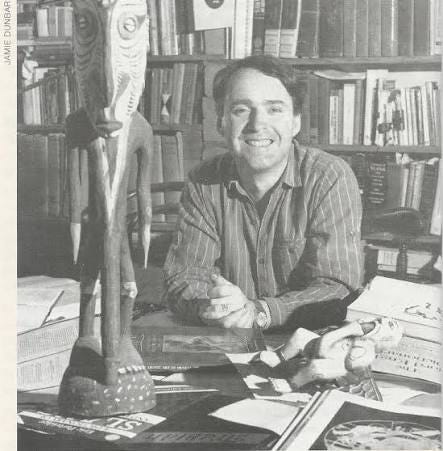
However, time passes when you’re working as much as it does for alleged fun, and given that we have arrived at early July, the new material I and GDoS’ infinitely valued band of contributors have gleaned over the last 90 days becomes eligible for display. For myself, the premium obsession has been finishing off my disembowelling of the late Dr Gary Simes’ tragically unpublished Dictionary of the Language of Sex and Sexuality.1 Those who hold the rights to his work, guided by GDoS Contributing Editor Jim Lambert, have permitted me to extract therefrom whatever might benefit GDoS. I am hugely grateful for such generosity. I have been at it for over a year and while there were, as ever in lexicography, moments of exhaustion not to mention those when Dr Johnson’s ever-remembered drudgery seems all too intrusive, it has been wholly worth the devotion. I had just finished ‘Q’ when last I did an update. Now the entire MS, including the monstrous ‘S’, has been read and put to work. Users can benefit from near 5,200 citations culled from those that Gary found for his lexicon. A good number back up the use of new headwords, but most give extra senses for terms GDoS already listed, but had not pursued so far. There are faults in the text, there are faults in any text, but I cannot but feel sincerely sad that Gary was never able to urge his great work across the finishing line. Every citation I have used is credited. Please take note.
For the purposes of utility and information, I offer a few stats on the current status quo: GDoS in its entirety has reached 57,935 headwords, in which ‘nest’ 159,976 definitions/senses. Of new material gathered since All Fools’ Day - whether new terms, definitions, predates or simply new textual examples that fill chronological or geographical gaps - there are 4,178 examples. NEW TERMS total 440; PREDATES 446. while the support upon which the entire edifice rests, the illustrative citations, have reached 659,345 in total.
If I use ‘I’ here, it is because some jobs are for me alone. But this has never been a solo project. I may have no publisher, and thus no editor, publicist and all the once mandatory rest, but I am fortunate in those individuals who not merely appreciate but actively improve the work.
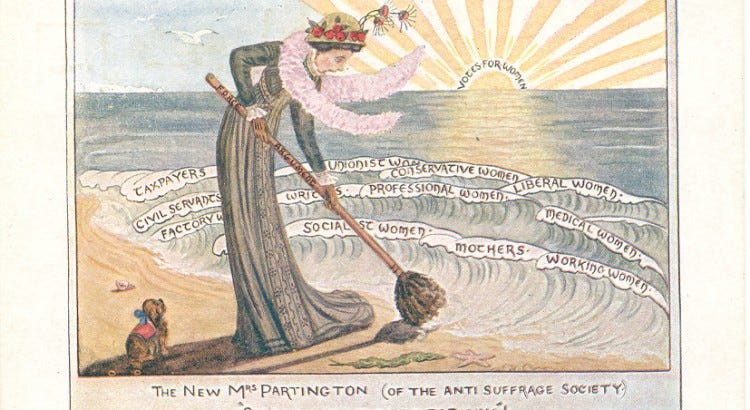
As ever, we benefit from Jim Gibbons’ invaluable researches. His star performer this quarter being the mid-19th century American lawyer, musician and diarist George Templeton Strong (https://en.wikipedia.org/wiki/George_Templeton_Strong). Other exploration adds more titles from the British-Jewish novelist Gerald Kersh, most of whose work has now been sampled for its counter-language; we also have further material from the gay writer ‘Richard Stevenson’ (Richard Lipez). He has also sampled Samuel Putnam Avery, another of those prolific, if almost wholly forgotten (could it be their obsessive use of pseudonyms?) 19th century American comic writers.2 As I wrote in Language! (2014) they included ‘Charles F. Browne (‘Artemus Ward’), J.F. Lowell (‘Hosea Biglow’), T.C. Haliburton (‘Sam Slick’) and Seba Smith (‘Major Jack Downing’). Others included Charles Henry Smith’s ‘Bill Arp’ (the Southern point of view); the Ohio journalist David R. Locke as ‘Petroleum V Nasby’ and Mortimer Thompson who wrote as ‘Philander Q. Doesticks’. Female characters included B.P. Shillaber’s ‘Mrs Partington’, whose Life and Sayings were published in 1854, and Frances Miriam Witcher's ‘Widow Bedott’ whose Papers appeared in 1856. While their primary purpose was satirical, their use of colloquialisms, often shading into slang, made them a useful source for lexicographers. Examples of most can be found in GDoS.
Jim also offers ripe trufflings gleaned from the translation of the Latin poet Martial’s Index Expurgatorius, a volume that brings together such of the author’s epigrams (the bulk appearing in 12 volumes between 86-103 AD) that were considered too obscene for print. The 159-page volume appeared in 1868 and left nothing (or should it be everything?) to the imagination. A fine sampler of filth’s splendid longevity.
There are those from whom we might expect slang and we have chased a good selection down. Tell me I’m wrong but the country music megastar Dolly Parton (I have nothing against but nothing especially for) would never have been one whom I might have included. Fortunately my fellow JG is less hidebound. GDoS is proud to present a substantial representation of the diva’s off-piste lexicon.
Oh yes, lest I forget, I also had the opportunity of a brief return to George Vere Hobart, a best seller of his time, especially under his pseudonym ‘Hugh McHugh’. I wrote of him and his characters, especially John Henry, here
jonathongreen.substack.com/p/george-vere-hobart3
This was the one book I had not found when for a while I collected the great man. Its title Boobs, which refer to hicks and rubes and the naivete they offer on arriving in the great city. The mammarian versions come later, although bubby and bub pop up respectively in 1681 and 1826. While the latest ‘McHugh’ doubtless tore the readers up when it appeared in 1914, I doubt that the title would raised a snigger. Stats again: there are 51 citations, of which 23, a very respectable 45% represent new coinages.4
Whither now? What is due for the next label new26C, the conclusion of which, after all, will notch up the first decade of online life for GDoS. All one can promise is hither and yon. I commence every 90 days with the blank screen, as terrifying as such things always are, and reach the end with novelty and reassessment jostling for space. No problems. Roll up, dear counter-language whether old, young, ‘clean’ or ‘dirty.’ I assure you: ‘unwelcome’ is another of those words of which slang’s dictionary has no conception.5 And it is me, I assure you, who will run out first.
Meanwhile, I have put together the lists that show what has been found over the last 90 days, and they should be accessible by downloading below. I believe one has in addition to click on the ‘hamburger’ button to the right for ‘download’ actually to launch. Please enjoy as much as do I.

‘Tragically’? An unfinished dictionary of ‘down there’ terms, and many of them referring to batters from the Pavilion end gobbling up (down?) a menu of bodily fluids? Let’s put it this way, no-one knows this dictionary-making world any better than me (you argue? will 40-plus years of every-day dedication do? and NB, the word ‘best’ is in no way claimed), and for those of us whose life and work have buddied up long since to abandon any fantasy that there might be a line drawn between them, to leave, for whatever reason, that making left undone, is as near a tragedy as I have ever approached.
I fear that their essentially ‘hick’ humour, dependent on taking the nativist mick out of those in the next village, or perhaps more likely an adjacent city or state, could never do it for me. Hard-conjured ‘funny’ names…well, if you say so. Like much of what we (well, certainly I) have loved about America’s magnificent culture, one needs await the input of immigrants, notably my own lot, and free African-Americans to get the show properly and productively on the road.
‘McHugh’/Hobart and a number of contemporaries, typically Helen Green van Campen (wrote about her too: jonathongreen.substack.com/p/dabblings-2) are what I like. They are somewhat later and their edge has been sharpened by rampant modernity.
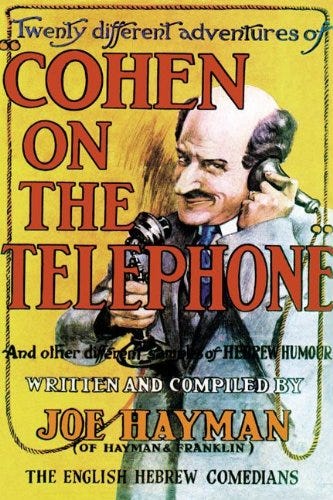
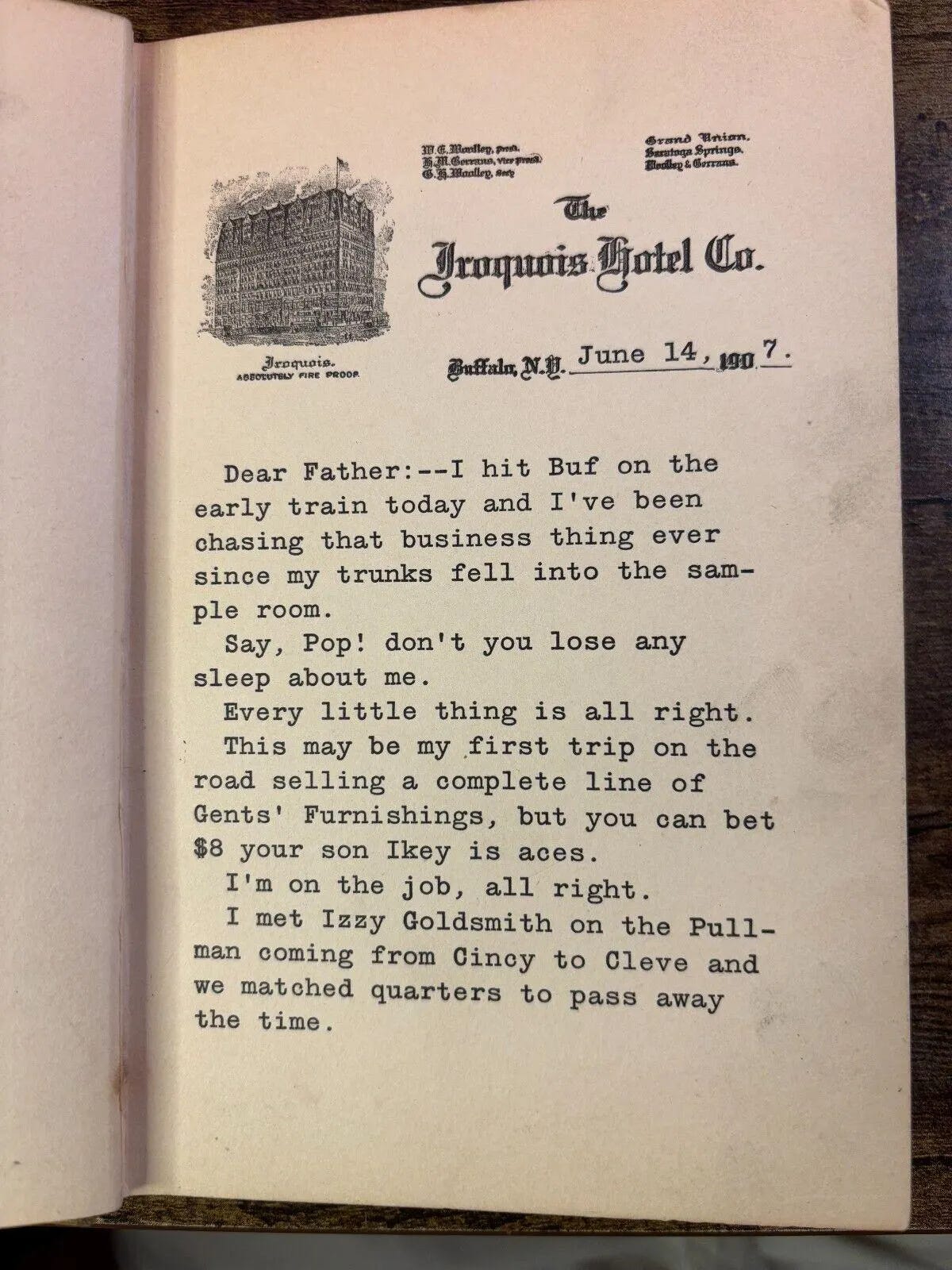
In addition I offer 42 cites from an earlier effort, as Hobart, and entitled Ikey’s Letters to His Father (1907). Yes, that ‘Ikey’ signifies just what you might expect, but this is no grotesque piece of stereotyping à la Cohen on the Telephone. Father, long off the boat, speaks as an older figure, but ‘v’ and ‘w’ are in their right place and Yiddish does not appear. Ikey, for whom peddling his father’s range of clothes has little appeal, is a youthful hustler, all slangy mouth and a great desire for some complaisant cutie to help remove his trousers. I think he will go to try his luck in Hollywood soon.
It has, however, a number of synonyms. For a start I suggest greensdictofslang.com/entry/cnx4xiy#qulhexq, which considers the fate of the hapless pork chop at the Jewish wedding.
The best keeps getting better. You mean a nice set of dollies isn't a pair of handtrucks?
Leon.
Thanks for your comment. You are, of course, welcome to ask what you will. But please note the following:
There are areas of 'the Sixties' on which I would be happy to pontificate, and might even be useful to a researcher, but this is one where I can best to hand you over to my interviewees. It is 40 years or thereabouts since I did the interviews for DITL (which of course formed the spine of ADU). It is even longer since the Poetry Reading itself (to which I didn't go, being 17 and still at school). To be honest, and with no intent to be negative, I am not sure that I could offer anything that is not already in Days in the Life. Sadly, all too many of those I interviewed are dead and if I could help I would. But as I say, the book and those within do it best. The best I could do, I fear, is quote.
Regards,
Jonathon