Bitching
Wandering Whores

[Slang, we are informed, is a ‘man made language’, coined and used by the crested rather than the cloven. Slang is also cussed and contrarian, as am I, one of its collectors, and with that masculinist diktat aforethought, I long desired to see what woman’s real role might be, other of course than as an object of desire or disdain. I called the project Bitching, which I felt summed up both sides of the stereotype. My eventual publishers (there had been many rejections) duly succumbed to their own conniption fit; the published title was Sounds & Furies, a very second-rate revision, and it appeared in late 2019. The role of the prostitute, and of her language, obviously plays a major part. Here is some of the pertinent chapter ‘Working Girls’.]
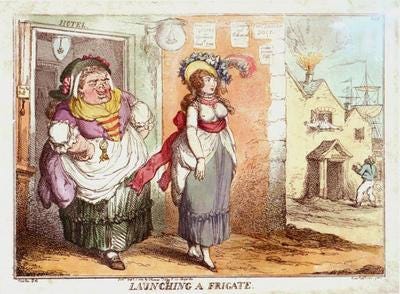
Around 1650 there appeared in Italy La Puttana Errante (‘The Wandering Whore’), a dialogue between Magdalena, an experienced old bawd, and Julietta, a relatively innocent whore. It declared no author but its format – a dialogue – and its inclusion of 35 plates illustrating the positions of intercourse, echoed the earlier Ragionamenti, created around 1525 by Pietro Aretino, a wit whose scathing satires had earned him the title ‘the Scourge of Princes’. The text itself would not be translated until 1827, but between 1660-63 there appeared a succession of pamphlets using the title ‘The Wandering Whore’. Their format, a dialogue between the old whore and the novice, aped that of the La Puttana Errante and indeed simply English-ed its title.
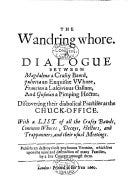
In all there were five pamphlets, each of sixteen pages and cheap enough to satisfy the purses of any reader in search of accessible titillation. The first was The Wandring Whore, sub-titled: ‘A Dialogue between Magdalena a Crafty Bawd, Julietta an Exquisite Whore, Francion a lascivious gallant And Gusman a Pimping hector. Discovering their Diabolical Practises at the Chuck-Office. With a List of all the Crafty Bawds, Common Whores, Decoys, hectors, and Trappaners and their usual Meetings.’ Its publisher, and very likely author John Garfield (of whom we have no further information), claimed that it had been ‘Published to destroy those poysonous Vermine which live upon the ruin and destruction of many Families.’ The reality was that like many pornographers before and since, Garfield used his proclaimed disgust to offer as much smut as he could get away with. Like the later Catalogue of jilts, cracks, prostitutes, night-walkers, whores, she-friends, kind women, and others of the linnen-lifting tribe(1691) and the multiple editions of the 18th century’s Harris’ List, it promoted a list of currently working girls.
Follow-up titles included: The wandering whore continued (1660) which featured the same discussion group; Strange nevves from Bartholomew-Fair, or, the wandring-whore discovered her cabinet unlockt, her secrets laid open, vnvailed, and spread abroad (1661); Strange & true nevves from Jack-a-Newberries six windmills, or, The crafty, impudent, common-whore (turned bawd) anatomised and discovered in the unparralleld practises of Mris Fotheringham ... with five and twenty orders agreed upon by consent of Mris Creswell, Betty Lawrence (1661) and The Wandring-Whores complaint (1663).
The Wandring Whore offers a mix of stories, focussing either on criminal trickery or on sexual pleasures, invariably ascribed, however, only to degenerate foreigners. It is full of bawdy humour and uses a number of military and naval images. And like later guides to London prostitutes it names streets and real-life whores such as the sailors’ helpmeet Damaris Page (mentioned by Pepys) and Madame Cresswell (a successful madame for 30 years until her arrest in 1681.
Cresswell can also be found in The whore's rhetorick calculated to the meridian of London, and conformed to the rules of art (1683) by ‘Philo-puttanus’, i.e. ‘whore lover’. It offers some 130 examples of contemporary slang. There are the first uses, which include as long as one’s arm, tearing, for impressive, cock-broth a strong soup, presumably seen as a sort of culinary viagra, and hit, to take effect. There were the predictable range of sex-related terms which offer both the obvious: cunny, cunt, fuck, ride, stallion and tail, and the more imagistic: the best in Christendom (the missing word being ‘cunt’; the phrase was usually found as a toast), the touchhole, the fancy bit and the punning low countries for vagina. The penis was often a trapstick and another bawdy pamphlet, Mercurius Fumigosus noted how a milk-woman ‘bitt off her Husband’s Trap-stick because she found him at Trap-ball in her Neighbour’s ground.’[1]
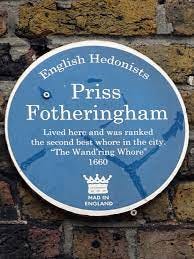
There were a variety of xenophobic terms for venereal disease: the French pox and the Neapolitan disease, both of which burned the victim, plus the Italian padlock, a chastity belt. As well as to be clapped, peppered and pocky. The Whore also offered what may be the earliest take on ‘as the actress said to the bishop’, in this case ‘Every man to his trade, as the Rat-trap-maker said to the Parson’. Intercourse was business, fancy work, knocking or dancing and a prostitute was a buttock, a hackney or a trader; her pimp a smock merchant and her client a rumper. She worked in a dancing school, or brothel. Of particular note was the title’s reference to the chuck office. This was a ‘game’ whereby a whore would stand on her head, exhibiting her spread vulva and clients would throw coins into her exposed vagina. As the first edition of the Wandring Whore reported in 1660: ‘Witness Priss Fotheringham’s Chuck-office, where upon sight thereof, French Dollars, Spanish pistols, English Half-crowns are as plentifully pour’d in, as the Rhenish wine was into the Dutch wenches two holes till she roar’d again, as she was showing tricks upon her head with naked buttocks and spread legges in a round ring, like those at wrestling neer the Half-crown-chuck-office, call’d Jack-a-newberries-six windmills.’[2] Ms Fotheringham’s own name for her vagina was the rima magna, the great cleft, the cash-tossing punters were cully-rumpers.[3]
The language of 17th century sex, as seen in the Wandring Whore and its various clones, was nothing if not inventive. As well as the terms noted above, a selection of those referring to intercourse included basket-making, bestial black-slidings (either rear-entry position intercourse or sodomy), the blow that never smarteth, latitudinarian principles (Latitudinarians were opposed to Puritan self-denial, which they considered harmful), the monster with two bellies (playing on Shakespeare’s beast with two backs, coined for Othello in 1604), the path that is first trod, violin-playing (a play on instrument, both vagina and penis) and letting blood near the leg and loin. As well as the established attributions to France and Italy, venereal disease could be the Covent Garden gout and the Piccadilly cramp, and to suffer it was to be clapt under the hatches, to learn French, and to be shot between wind and water. As is obvious, many these terms were puns.
_________
After the 17th century’s dialogues, the 18th and early 19th turned to memoirs. Fanny Hill may have been a fictional figure but the subjects of these supposed ‘autobiographies’ were not. The best-known madams of an earlier age, such as Damaris Page ‘the great bawd of the seamen’ who had flourished c. 1650 in London’s dockland red-light district Ratcliff Highway, achieved no more than an occasional walk-on as regarded print (for instance Page and Fotheringham’s joint appearance in a pamphlet of 1660: Strange and true Conference between Two Notorious Bawds, During their Imprisonment and lying together in Newgate...’ supposedly authored by ‘Megg. Spencer’, a well-known bawd herself and self-appointed ‘Over-seer of the Whores and Hectors on the Bank-Side.’). Her successors are recorded, quite literally, in chapter and verse.
Among those name-checked were ‘Mrs Elizabeth Wisebourn’ (1721), ‘The effigies, parentage, education, life, merry-pranks and conversation of the celebrated Mrs. Sally Salisbury’ (1722-3, and accompanied by a number of similar works), ‘the celebrated Miss Fanny M’ (1759) which included the rules of the Whores Club (‘1. Every member of this society must have been debauched before she was fifteen’) and ‘Miss Kitty F[ishe]r (1759), whose ‘uncommon adventures’ were also recorded as ‘Horse and away to St James’ Park’ (1760).
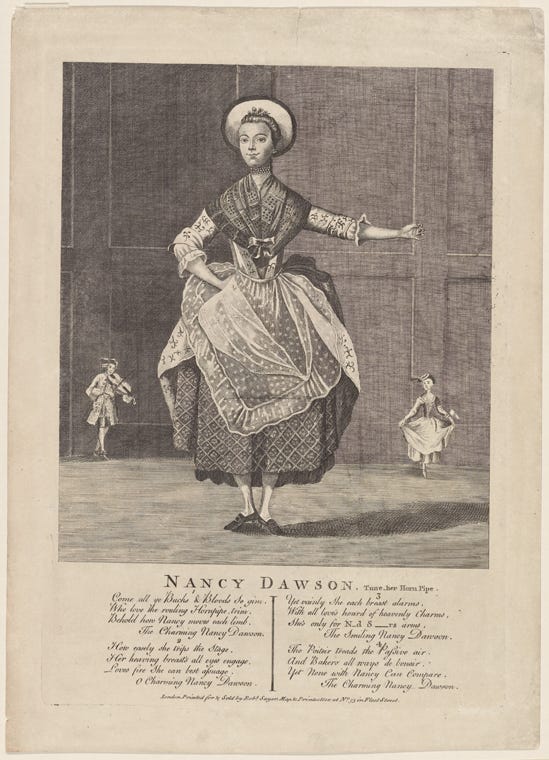
The list also includes ‘Genuine memoirs of the celebrated Miss Nancy D[awso]n’ (1760) whose book of ‘jests’ (Nancy was perhaps paid to lend her celebrated name) was a popular best-seller. Nancy was as much dancer as whore, taking a role in 1759 revival of Gay’s 1728 hit The Beggar’s Opera. Here she performed her speciality: the hornpipe (the punning potential of which may possibly have been observed). She died in 1756, leaving a variety of dances, sailor songs and this nursery rhyme as her memorial:
Nancy Dawson was so fine
She wouldn’t get up to serve the swine;
She lies in bed till eight or nine,
So it’s Oh, poor Nancy Dawson.
As well as non-specific round-ups of the foremost ladies of the town, such as Characters of the present most celebrated courtezans (1780) there were also such leering collections as The prostitutes of quality; or adultery â-la-mode. Being authentic and genuine memoirs of several persons of the highest quality (1757). The lip-smacking allure of posh totty is nothing new.
Other memoirs included The women of the town, or Authentick memoirs of Phoebe Philips (1801), The Secret memoirs of Miss Sally Dawson (1805), A curious and interesting narrative of Poll House and the Marquis of C***** (1820), Memoirs of the celebrated Lady C*****m (1820), Memoirs of the life of the celebrated Mrs Q------ (1822). A trio of early 19th century ladies – Margaret Leeson (1797), Harriette Wilson (1825) and Julia Johnstone (1825) – were keen to add in all their titles that the work had been ‘written by herself’. Unfortunately, even were this truly the case (and it would appear to have been so in that of Margaret Leeson) the ladies were at pains to present a respectable image, at least in their vocabulary. No slang here.
Perhaps the best equipped for our purposes was Jane Davies, the ‘genuine memoirs’ of whom, now feted as ‘the late celebrated’, appeared in 1761. Jane came from Edinburgh, where she had joined the game as a teenager. There she had been clapped, then cured and was ‘allow’d [i.e. acknowledged] to be the heartiest girl in town.’ This seems to have arisen from the fact that she ‘surpassed all her sister whores in swearing and obscene talk’. As a later comment puts it, she possessed ‘a peculiar turn to that species of eloquence, which though not treated... by Quintilian or Longinus [both Roman rhetoricians], is generally understood in the metropolis, and goes by the name of Billings-gate.’
She could also drink any man beneath the table, pausing only to empty his pockets of such money as remained before marching off. A later trip to Ireland, to recruit new girls, after she had become a Covent Garden madam, showcased both her talents. The ship ran into a storm and while weaker folk might wail and/or vomit, not Jane: ‘She drank flip [beer, spirits and sugar mixed and heated], and cursed as loudly as any sailor of them all.’
Ms Davies made no pretence to sisterhood. While she had to acknowledge the need to regard men – her paying customers – as deserving of at least counterfeit politeness, her dealings with women, be they the brothel’s inmates or the maids who cleaned after them, were antagonistic and her term of choice was bitch. ‘She scarce ever spoke to [maids] without using the appellation of ragg-doll b—h, or some other epithet equally indelicate.’ Unsurprisingly few maids stayed much beyond a week. Her house was known for its foreign girls – she made regular recruiting trips to France and established a pan-European network of bawds, trading girls between them (such travellers often miraculously regaining their maidenhead as they stepped off the boat) . This did not spare a particular girl’s French maid who, perhaps somewhat homesick, entered the brothel kitchen and started preparing potage, no doubt to some rich old provincial receipe learned at the maternal knee.
‘Old Jenny [Davies] who had a good nose soon smelt the stink of leeks, and called out, G—d d—n me, who is that poisoning my house below. Answer being given her That it was only M—le’s maid making a little soupe. D—n the French b—h cried Jane, I’ll give her a bellyful of soupe by and by. So Jane having provided herself with a close stool pan [a chamberpot] which was full, ran to her, and throwing it full in her face, cried, Here you French b—h, here’s soupe enough for you, you shall never wanted for soupe...I’ll season it for you you b—h, G—d d—n ye.
The memoir runs from one lurid anecdote to another. Another tale concerns a brother and sister (again French) who, wholly ignorant of their true relationship, she had as she believed introduced to each other (pimping out the girl to her brother). Despite a plot which might seem to be leading to farce if not actual incest, Ms Davies would be for once the victim. The pair robbed her, and left, after poisoning her supper. Her response was predictable:
G—d eternally d—n all the French b — ches! may their own country disease, the p—x, rot them to the bone! May they be all covered over with ulcers, their noses drop off, and may they all die upon a dunghill and the devil run away with their souls! Amen.
There followed ‘a good deal more, in the same stile and tone’. At which she fainted and was ‘quite unfit for business that day.’
She was 74 at her death, a respectable sum of years. The compiler of her memoirs concluded thus: ‘Old Jane had a particular talent for smart sayings, though there generall enter’d a good deal of that sort of humour into them, which is common among fish-women and upon the Thames. A Person who was intimately acquainted with her made a collection of her bons mots and […] we shall publish it entire.’
Sadly, this embryonic clickbait was unfulfilled. The small print, as it were, made it clear that such a ‘best of...’ compilation would only appear were the memoirs a hit. We must assume, in the compilation’s absence, that this was not the case.
[1] Mercurius Fumigosus 17 (Sept. 1654) p. 152
[2] a blue sign, mimicking the official memorials, has been mounted in honour of Ms Fotheringham in Whitecross Street, EC1, known as one of her era’s great centres of vice and still cited among London’s most wicked and dangerous streets by 19th century sociologists. For further detail see G. Williams A Dictionary of Sexual Language and Imagery in Shakespearian and Stuart Literature (3 vols 1994) I 242.
[3] there was a male equivalent: the Prick-Office whereby a man stood on his hands naked and with ‘T[arse] upwards’ and had the tip of his ‘Trapstick’ kissed by a succession of women who paid for the privilege.