A Word’s Gotta Do...
Shock? Horror? If I Must.

[Another attempt to ponder what I do and how some might feel that pouring oil on the fire, even in lexical terms, doesn’t a help a world that is already burning - lit. and fig. both - so very brightly. I believe what I write, but have no illusions that I answer (m)any questions, even my own.]
A decade or so back (it was 2012) I went to an exhibition at Paris’ Musée de l’Art Moderne. It was dedicated to the work of Robert Crumb, former ‘underground’ cartoonist’ and by then an internationally celebrated creator considered worthy of a substantial show – some 600 pieces – in a major temple of capital-A art. That it was in France combines both the country’s long-time respect for what are called bandes desinées, and the fact that Crumb lives there, in the south-west. As it always has been, his work was outstanding, much of it taking me back 40 years to my own ‘underground press’ career; there was even, in a large montage that rounded off the show, the cover of an OZ magazine on which I was working in summer 1971.
I haven’t really kept up with Crumb. Nor have I seen much that might be termed ‘underground comics’ of late. The nearest is reading some graphic novels, especially the French romans noirs of such as Jean-Patrick Manchette, Didier Daeninckx and Leo Malet that have been re-created in this visual format (known as bandes dessinées) and illustrated by the pen of Jacques Tardi whose work has also encompassed the Paris Commune and World Wars I and II. There are also, of course, Art Spiegelman’s remarkable two-volumes of Maus, but there is nothing comic about them, and this ‘underground’ is truly satanic, not counter-cultural.
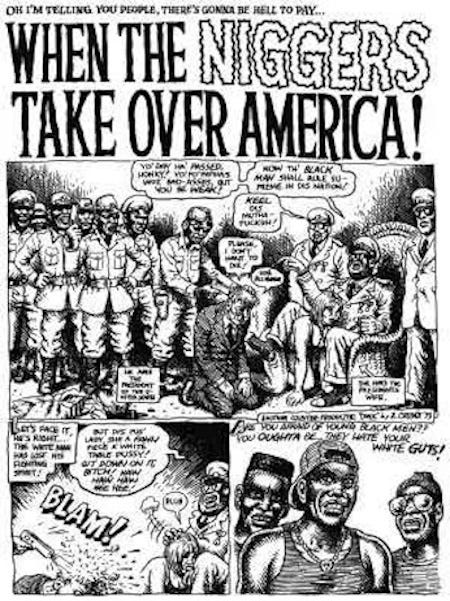
But mainly I still opt for traditional blocks of text. To an extent it is the quest that impels my reading - a vital part of the unending search for slang - but it is also of longer-term pedigree.1 So I had missed a pair of Crumbs that, without comment, but each in their 3-page entirety, were among those original artworks included in the show. Both had appeared in 1993. One is entitled ‘When the Niggers Take Over America’. Its bookend is ‘When the Goddam Jews Take Over America’. Both trade on the grossest of racial stereotyping, whether visual or verbal and underlined by a wide range of slang’s stock-in-trade, racial slurs. The entirety of such terminology is nothing near on offer – African-Americans and Jews topping out by a wide margin any other subjects of slang’s race-based viciousness – but there are enough.2
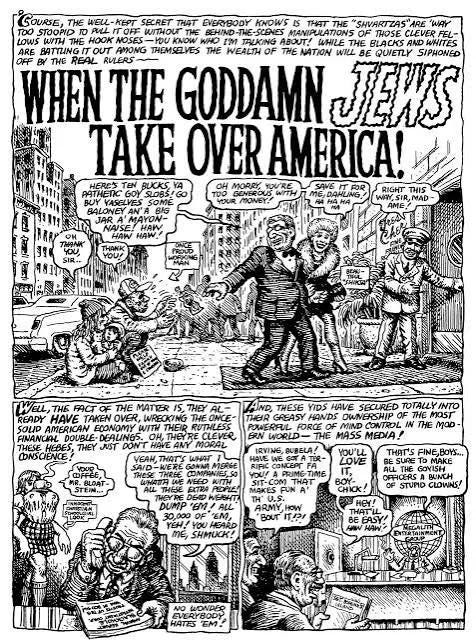
I cannot speak for others – all of whom were seemingly French while I was there and these, in the original drawings, were not translated – but my response was barely muted laughter. Especially for that which dealt with my people. Crumb’s unfettered parading of every racist trope had gone so far over the top; how could one not laugh, albeit that we would not cry. This was Swiftian satire of the highest order. How else could Crumb’s glorious parodies of bigotry’s mindset possibly be interpreted.
Back home, since I’d missed them first time around, I started googling for background. I was wrong. The cartoons had caused widespread offence. Crumb was condemned both as a racist, despite his his well-documented adoration for the black musicians of the 1920s, and an anti-semite despite having a 30-year marriage and working relationship with a Jewish woman, Aline Kominsky (she died in 2022).3 Piety and pomposity ruled. Sorrow, perhaps, but much more anger. Nor only offence, celebration: a neo-Nazi rag promptly and approvingly reprinted the works. Crumb expressed regret but withdrew nothing. As I say, I was wrong.
This is not to judge Crumb, self-confessed as deeply neurotic and an artist, hardly the first, whose internal demons inform his genius.4 For what it is worth, I do not agree with his then PC, now woke critics, let alone those who hijacked his satire to be supportive of their own sickness. My thought, and I have had it before as regards my work, is this: where does my own response leave me and my unrelenting display of all his terms and thousands more? Have I missed something, is there something missing in me? Am I, as the god-bothering and wilfully obtuse British morals crusader Mary Whitehouse (no, don’t bother to look her up) used to claim of the consumers of pornography, corrupted in some way by my work. Or if not corrupted, then coarsened beyond understanding, hardened against empathy, careless of the feelings of those more sensitive. I prefer to think not. I am, however, beyond shock5 and whether this is a lifetime’s cynicism or forty-plus years of researching words that work out their existence in humanity’s lower depths I cannot unequivocally say. Perhaps it is a closed, and in every sense vicious circle.
The mainstream slang lexicographer, usually middle-class, middle-aged, law-abiding and white6, is ultimately a voyeur. Nor, as I have written elsewhere, are we merely voyeurs upon the sensational. ‘Disinterested, unmoved, we are heartless; we have no human interest. Nor human interest stories. Just words, words, words. The beggar is whipped, the whore has a back-story, the junkie dies. We do not care. Only if frustratingly, impudently, they remain mute.’
That I ignored the wider list of those who face racial abuse reflects the time I was writing. There was still a sense that, whatever variety of such sickness one wished to express, it had better be muted. That is over. Hope, to quote a line whose author I forget, is powerful, but hate is the way to go. And so the world proceeds and the emotions and language that underpin Crumb’s diptych, once so shocking, is SOP.7
The problem, if there is a problem, is that if one takes one’s occupation seriously, and I take mine very seriously, one has no time for debate. Work is to be done, let others pick nits. I would imagine that Crumb would say the same, though I would not compare my abilities to his. Slang by its nature has no time for kindness. It lacks empathy. All price, no value. Cruel and heartless though it is, its role is to forsake wishful thinking, highlight what is, not what should be. That is not to say that the racist slurs are correct, they remain vile, but that however we may deplore them, they exist. Stereotypes shine with the malign patina of centuries.The dictionary-maker is a witness, not a judge. And yes, like any witness, parti pris.
If there is an effect then it is on my world-view. I know that grey is the real primary colour, that black and white are just too simplistic, but slang has little time for nuance, it prefers stereotypes. In this it suits our world, where the centrist, refusing to brandish either flag or slogan, nor scream the attendant epithets, is the lowest of the low.8 This is a world of extremes: all men are violent, all women promiscuous, all politicians corrupt, all rich men megalomaniac, all authority venal. All opponents are to be extirpated. Fill in your own despairing nouns and adjectives. A noir horizon that stretches out in every direction. If there are solutions they are noir too: such as those offered in Horace McCoy’s No Pockets in a Shroud or Daeninckx’ Le Der des Ders (‘The War to End Wars’) in both of which the hero, on the final page, on the very edge of winning through, is murdered.
So Crumb’s hook-nosed Christ-killers, and his ebony-hued vulgarians, like the slang terms that are coined to give them form, exist because, however repellent, this is what sufficient people think and what once again they are quite happy to continue speaking. Race, religion (and how I love France’s use of culte for the latter) and every kindred form of true belief are always ready to pull open Hell’s gates and delight in what they’ve made.
I have known this as long as I have been slang-gathering. But surely, serious again, I have no choice. No way would I censor a racist term (nor any other that having inserted the blade, delights it twisting it and dances exulting to the agonised screams). Slang dictionaries are descriptive by default: what we see is what we ensure that you get. Nor, other than some knuckle-dragging school board in Florida, has anyone demanded that my work be ripped from its library shelves. For the alligator state, I should add, the problem was not ‘filth’ or the plethora of racism, merely the appearance of Christ as an exclamation rather than what I, a young four-by-two, always read as ‘the Savoury’ and wondered accordingly.9
Sticks and stones and all that, is it not. As one who suffered (and gave out) their fair share of teasing, I was far from impervious to verbal savagery and if well-aimed, words did indeed hurt. But on the whole it wasn’t anti-semitic. It was, I had no informed idea but gradually, the more I learned of the Shoah, it was obvious that the world had, French again, chosen reculer pour mieux sauter: to back off so as to attack with more vigour next time. Quite when the tide would build up once more and coming in with renewed energy soak those who, unaccountably but much very gratefully, stayed dry as decades passed by, was the question. But it was a when question, never an if.10
But there was, for a while, what seemed like a period of safety. We could make our jokes, mock those who spouted the cliches of hatred, and in my case compile great lists of loathing’s lexis, because it seemed that we were living within that rarely used but far from defunct phrase, a safe space? For a brief moment, it was that those who used these terms who knew they were wrong, that it was they who were hated, excluded from literal or figuratively ‘polite’ society.
Nothing, of course, lasts.
The long pause is over. ‘Never again’ proved itself an interregnum, not a seismic shift. That those who, however grudgingly, shut away their hatreds from public exposure, are shouting them in every street. That the scum, and do not mistake that term for a class-based critique, has yet again risen. So my question is now, bereft of that ephemeral post-war confidence (all right, let us say self-delusion), does it make any difference to my work. Should I turn prescriptivist, should I add censorious asterisks to my nastier entries, or even remove them entirely. What draws our eyes more efficiently than partial excision, unless it be wholesale absence. Nor, of course, would this highlight only my lot whom I have noted simply because they are mine, but all - let’s call them immigrants - who have been condemned as ‘the bad guys’, the bearers of all that qualifies as ‘ill’.
I do not expect that those who use my work will need much time to reach a verdict. The answer, what else might it be if a shred of honour and honesty might find a place in what in turn remains of my life, is fuck you charley! I’ve said it before, and Lenny Bruce said it before that: there is no what should be, there is only what is. Slang records reality. It offers us at our most human and ferchrissake, who ever releally believed that ‘humanity’ was some limp-dick, cow-cunted synonym for ‘kind’.
The dictionary is not there to act as a protector. ‘Is it in the dictionary’ remains a useful question (and feel free to chose your own digital synonym), but what ‘it’ might turn out to be is another story. One that, for all my delusions, it has been telling us all along.11
I am all too aware of the meaning of my unashmed self-denial. No more would I have tucked in to YA titles had such things existed. Comics (though I exclude newspaper strips which have provided many solid examples to GDoS) or so they were when I was a teenager, were what the thickos read. The world of Marvel and its clones still seems that way to me. It is, perhaps, evidence of the cultural snob - paradoxical for someone of my profession - but I can’t really throw that off. However much I adore Tardi’s evocation of what France terms polars, it is as much because of and not despite the book he illustrates.
If you’re really keen, check these out: https://timelinesofslang.com/religion.html, https://timelinesofslang.com/race2.html
No, ‘some of my best friends’ hasn’t suddenly joined the acceptable excuses list and ‘some of my best 78s’ certainly doesn’t qualify either. Nor, before anyone smart-arses in with the propensity of the latter, the Jewish mother, to justify the former, the Jew hatred, I would note that there were no children. I would add that yes, I am well aware of the ability of Jews to be as vile as members of any other ethnic group. Yet I still don’t see Crumb as a racist any more than his depiction of ‘Honeybunch Kaminski, 13, of L.A.’ renders him a paedophile.
For chapter and verse, I recommend Dan Nadel’s print biography Crumb (2025) and Terry Zigoff’s documentary Crumb (1994). Hagiographies they ain’t.
Shock, that is, as generated second-hand, as is pretty much invariably the way for we dicionary-makers. I have never walked a recent battlefield, experienced the aftermath of an invading army, stood in a torture chamber. The nearest was visiting Auschwitz where I felt tears rolling, but tried very hard to impose my kneejerk cynicism as regards my fellow humans.
Keeping things anglophone, I am very well aware of African-American slang lexicographers. I have used their work and am duly grateful. But by definition their books focus on a lexical subset even more focused than does mine. Though subset becomes ever-less valid: that that lexis has, maybe since World War I, and certainly World War II become slang’s dominant fount of neologism (and not just amongst English speakers) is a story that transcends any footnote.
Am I alone in sensing the vast sigh of relief in the UK when suddenly, with the Brexit triumph of June 2016, a seismic change did eventuate, and if ‘sovreignty’ was the head of the new-minted coin, however base, then ever-louder, ever more open hatred of immigrants was the tail. As for those whose response to October 2023 was that ‘the Jews had it coming’ and have now transmuted a government’s sociopathic excesses into condemnation of an entire wordwide community, you really shouldn’t be following me.
The OED revised centrist in 2016. There is no mention of its current role, at least in social media, as a term of contempt.
I was vaguely aware of communion, maybe it was the bikkies? But surely not: our faith-powered baked goods, matzohs, were singularly tasteless, savoury definitely didn’t enter that equation. Though ha! maybe the goyim, once more rejecting the stern Old Testament, were taking the more easily palatable route.
As that tide begins to break I must discard one of my long-held illusions: that the suppression of open Jew hatred was down to guilt. That people felt bad about the Shoah. Of course I was wrong. They may have felt bad, but merely that it had not been done properly. Next year in Auschwitz. (A joke, if a grim one. IYKYK).
The current description of the terms that GDoS has in such profusion is, I gather, ‘hurty words’. The infantilism of that phrase sticks in my throat and sends me searching for an origin in a pre-schoolers’ rhyme, probably listed in something by the Opies.
Back in 2012 those two 'comics' both made me laugh but there was side that also found it remarkable that they had been included. I haven't seen the Zwigoff but recommend the print biography. RC does not come over as Mr Stability. But none those we loved - Yossarian, S Clay Wilson, Gilbert Shelton etc etc - were holding back. Nor would we have wished them to do so. Up against that wall, motherfuckers! And now, where in hell are we. I found it hard to make the words speak as required. Too much nuance, too much contradiction, too much woddafug? Maybe have to try again.
I watched Zwigoff's Crumb doc and have read various works of his (these were both new to me) including his over the top satires of racism. The issue always is that hate and fascism sink to levels that are beyond satire and mockery, so much that "Not the Onion" is a familiar tag on news items, referring to the infamous satirical newspaper and website I'm old enough to recall reading the actual Onion newspaper, when I lived in Minneapolis; Zwigoff, and The Onion, are both from nearby Wisconsin.
In college, I wrote a satire about how bullets were cheaper than rehabilitating people; the Young Republicans wanted to print it in their paper. Because over the top satire is used by fascists to move the Overton Window (of what is acceptable) to the right, bit by bit, until we shrug at concentration camps and rampant kakistocracy and corruption.